John Rackham
Calico Jack
c.1682 – 18 November 1720
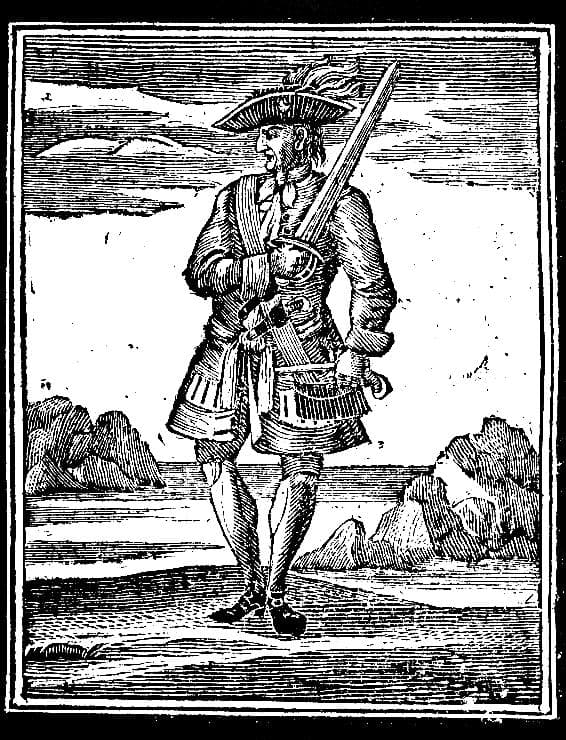
John Rackham earned the nickname Calico Jack for the brightly printed Indian cotton — calico — that he favored for his clothes. He served as quartermaster under the pirate Charles Vane before leading a mutiny against him in November 1718. Vane had refused to engage a French man-of-war; the crew, by majority vote, deposed him and elected Rackham captain.
A short and merry career
Rackham was never the most successful pirate of his age, nor the most violent. He took small prizes — fishing sloops and coastal merchantmen — around Jamaica, Cuba, and the Bahamas. He briefly accepted a royal pardon at Nassau in 1719 but soon broke parole, stealing the sloop William from the harbor and returning to sea with a small crew that included Anne Bonny and Mary Read.
The flag
The flag Rackham is said to have flown — a white skull above two crossed cutlasses on a black field — became one of the most enduring images of piracy. Most renderings of the "Jolly Roger" descend from his design or from variants of it.
Defeat
On 22 October 1720, the pirate hunter Captain Jonathan Barnet caught the William anchored off Negril Point, Jamaica, while most of Rackham's crew were ashore or drunk in the hold. Only Bonny, Read, and one other man fought on deck. The rest were captured without much resistance.
The rope
Rackham was tried at Spanish Town, Jamaica, and hanged at Gallows Point near Port Royal on 18 November 1720. His body was afterwards gibbeted on a small islet at the entrance to Port Royal harbor — known thereafter as Rackham's Cay — as a warning to other pirates. Anne Bonny is reported to have visited him in his cell and told him she was sorry to see him there, but had he fought like a man, he need not have been hanged like a dog.
Related: Anne Bonny · Mary Read · Port Royal