Bartholomew Roberts
Black Bart
17 May 1682 – 10 February 1722
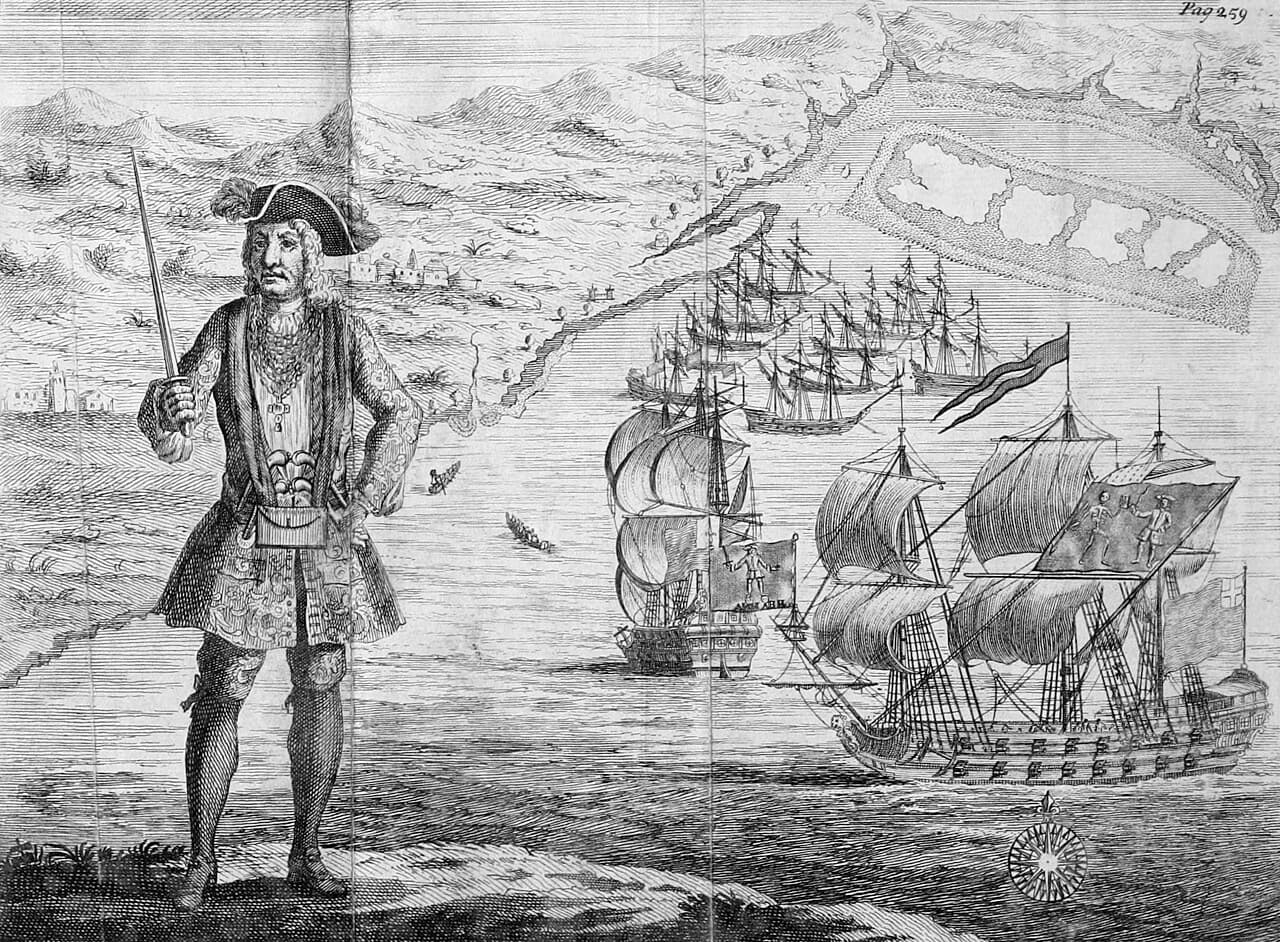
Black Bart Roberts was, by the bare arithmetic of plunder, the most successful pirate who ever lived. Between 1719 and 1722 he and his crews captured more than four hundred prizes — more than Blackbeard, "Black Sam" Bellamy, and Henry Every combined. He drank only tea, dressed in scarlet damask, and was buried at sea in his finest clothes.
From captive to captain
Born John Roberts in Pembrokeshire, Wales, he was serving as third mate aboard the slave ship Princess in June 1719 when Welsh pirate Howell Davis captured her off the Gold Coast. Roberts was pressed into the pirate crew. When Davis was killed six weeks later in an ambush at Príncipe, the crew elected Roberts captain. He changed his name to Bartholomew and accepted the command with a famous formulation: that since he had dipped his hands in muddy water and must turn pirate, he would rather be a commander than a common man.
The pirate articles
Roberts's crew operated under a famously strict written code: no gambling, lights out at eight, women and boys forbidden aboard, and a fixed share of all plunder for the wounded. He drove the crew through the West Indies, then north to Newfoundland — where in June 1720 he sailed his sloop into Trepassey harbor flying the black flag and captured twenty-two anchored vessels in a single afternoon.
Off the coast of Africa
By 1721 Roberts had returned to the Guinea coast in the forty-gun Royal Fortune, taking slave ships almost at will. The Royal Navy dispatched HMS Swallow under Captain Chaloner Ogle to hunt him down.
Cape Lopez
On 10 February 1722, off Cape Lopez on the coast of present-day Gabon, Ogle's Swallow approached the Royal Fortune disguised as a merchantman. Roberts's crew were drunk on the morning's captured Madeira. By the time they recognized the warship, Swallow had already swung broadside. The first volley struck Roberts in the throat and killed him instantly. His crew, honoring his wishes, weighted his body in damask and threw it overboard before the British boarders could reach the deck.
The trial that followed at Cape Coast Castle hanged fifty-two of his crew — the largest mass execution of pirates in history. It is often dated as the moment the Golden Age of Piracy ended.
Related: Battle of Ocracoke Inlet